Sunday, 27 May 2012

Favourite cheapish hotels in China


This is a rough guide of our favourite hotels from our travels around China.

Firstly I should start with we are not that picky. We like hotels that are cheap, clean, well located, and have easy internet access. Anything else is a bonus.

We have only included hotels we liked. If we thought they were okay, we left them out, thinking you would be better off trying a random one on CTRIP or ELONG.

Take our advice as trying to help, but at your own risk.

Beijing

Home Inn Dongzhimen


Location, location, location. Right next to major subway station, bus terminals (to the Great Wall etc). Sanlitun and some tasty restaurants (our Sanlitun food guide) are just a walk away.

Chengde, Hebei

Bifeng Hotel


Short walk to the glorious Chengde Mountain Resort, our room had mirrors on the ceilings. Tip: Don’t be late with your time of arrival. We were 30 mins late and the receptionist seriously considered cancelling our booking! Note: the entrance is around the side/back from where you would expect.

Chengdu, Sichuan

Home Inn People’s Park


Next to the charming People’s Park that is lovely for a sit-down for a pot of Sichuanese tea. The cafĂ© in the hotel does a good beef noodles.

Dongsheng, Inner Mongolia

Hongye Hotel


A great stop-off point for viewing the wonders of Ordos.  The hotel has close bus connections to Ordos, and if you walk east, you can find the heart of the city, with charming restaurants and a big public square.

Guangzhou, Guangdong

Guang Dong Bai Yun City Hotel


A little noisy next to the train station, but near the wonderful Yuexiu Park, which I can walk around for days.

Hong Kong

Silka West Kowloon


If you want a step up from Chungking Mansions, this is the place. Cheap (for HK), close to the subway, and a moderate walk to sites including the Temple Street Night Markets. Great breakfast.

Jiuzhaigou, Sichuan

Youu Hotel


This quirky hotel/hostel is pretty, with interesting furnishings, friendly English speaking staff. Short taxi ride to Jiuzhaigou.

Kashgar, Xinjiang

Seman Hotel


This oddly named hotel has some great qualities. Nicely located, a wonderful restaurant with healthy safe-to-eat food, and they organise trips to the Himalayas and bordering countries.

HOWEVER, nearby is a Pakistani restaurant that is recommended in some guidebooks. As seasoned Chinese travellers, we went there, had the meat dish and were VIOLENTLY ill for 2-3 days, and remained sick for a week.

Qingdao, Shandong

Starway Hotel Qingdao Beer Museum


Well located for the Beer Museum, an extensive street market and vendors who will happily sell you beer in a bag, this hotel is cheap and has great service.

Sanya, Hainan

Huaxin Hotel


5 minute walk to beach, fresh fruit in the room each day. Yum! Note: Staff very inexperienced about registering foreigners to stay.

Shanghai

Starway Jiaxin Hotel


This isn’t a hotel for someone who wants to be in the centre of Shanghai. It is about 15 minutes from the centre, right next to two train lines. What I particularly like about this hotel is its surroundings. Walking around nearby will take you to a wide variety of restaurants. (Fast food close by, Chinese different cuisine if you go further) Avoid hotel breakfast.

Turpan, Xinjiang

Name unknown

Go to the Turpan bus station, and on Lao Cheng Xi Lu go west 100 metres. The hotel is on the north side of the street, roughly opposite the market entrance.

Good air conditioning (a must for Turpan’s 45C summer), cheap (RMB150/night for 2 rooms shared by 5 people), and well located opposite the main markets.

Xiamen, Fujian

Gulang Villa Hotel


Relatively expensive yes, but Gulang Villa Hotel is located on an island with a lovely European village-feel. Surrounded by fish restaurants, it is a great place to get away from people (in winter at least, it’s probably packed in summer!)

Yangshuo, Guangxi

Yangshuo Regency Holiday Hotel


Well located, stunning views out your window and a solid breakfast.

Saturday, 14 April 2012

The Amazing Adventure Race - Sydney 2012 Photos and Tasks!

Molldrew have both had a growing fascination with the Amazing Race adventure series. The prospect of dashing around the world solving clues seems an amazing challenge, considering all the logistical issues and strange challenges that you need to take part in.
From this idea, Molldrew and the Guihots decided to get together and create the Amazing Adventure Race. The rules of the event were based on the Polaris series in Australia, where teams would have six hours to go to various checkpoints around the city and complete tasks worth varying levels of points. Taxis were not allowed, but biking or using public transport was.
In 2011, three teams took part in the inaugural race in Beijing, Molldrew, the Guihots, and Kristen and Cait. A recount on that Amazing Race can be found here. http://molldrew.blogspot.com.au/2011/05/amazing-beijing-adventure-race-round-1.html
By 2012, we and the Guihots had left China for Australia. So Molldrew decided why not do it again here? 
This time NINE teams took part in the Adventure Race around Sydney. Some of our favourite photos (including those of teams doing checkpoints), are shown below.
Preparation

Teams hurriedly using their half hour to prepare.

Luna Park - Take a picture of a teammate under the teeth

Four teams go straight from the start to Luna Park

Filiz makes friends at Luna Park

David Jones - Take a picture of a price tag for an item that costs over $1,000

Some teams went into this task wanting to just quickly find something over $1,000 and get out of there. Sam and Rufina however, wanted to smash the $1,000 barrier.

 Ralph Lauren make tables? 

To quote Sam "Yes it was a nice table. But I couldn't imagine spending more than $5K on it."
Colindia Reserve - Walk the entire length of the beach
This clue was meant as a trick. While teams may have read the clue and envisioned a 2K walk, in reality the beach is about 20 metres long!

Some teams took the quick approach..

Willem halfway in his wide paced 'trek' across Colindia Reserve Beach
While Reece took a longer staggering version that was hilarious. When I get hold of the video, I'll post it below.

Flora and Knight Reserve - Climb the small climbing wall

With playgrounds becoming more safe these days, it is great to see a playground come up with an uber cool climbing wall!


Molly and Deb show different styles on the climbing wall

Food glorious food!
It appears teams love the food tasks, but only one team ended up taking all three food tasks: gelato at Leichardt, cream puffs at Chinatown, and portugese tarts in Petersham.


Careful planning by hosts ensured food kept coming

IKEA - Take a picture of a team member trying out the beds
Harking back to our Beijing days, this task asks teams to recreate the China IKEA experience, where families go to IKEA stores and let their kids sleep in the beds, and hold dinner parties around the dining tables.
 Brita takes a very dignified lie-down

  Sam and Rufina ran hard all day. Rufina takes a moment to have a micro-sleep.

Sydney Park - Find the human sundial exhibit and use it to tell the time.

Mental note: Don't rely on it being sunny when coming up with tasks!


Pete consults his watch to tell the time after clouds render the sundial useless.

Darling Harbour - Divert a small stream

This cryptic clue lead teams to do a variety of things. What we (and Deb and Willem) did is head for the kids playground, where they have water flowing down a hill. Kids can change which way the water flows by moving a gate.


We like teams doing tasks their own way - Willem and Sam show different ways to divert a small stream in Darling Harbour

Paddy's Markets - Buy Andrew a quirky birthday present. Maximum spend: A$10. Most quirky present gets 20 bonus points

Boy did this ensure we recieve a remarkable selection of gifts. Everything from Chinese lanterns, boxing kangaroo pens to ice cream sunglasses.


The winner however, came from Anton and Dee, with their 3 x 3 x 4 Rubik's cube.


Art Gallery of NSW - Take a picture of an artwork with a dog in it


Very cute and fluffy!

Afterwards, dinner gave teams a chance to exchange stories of the day


The winners with their trophies

 Well done to Sam and Rufina! Worthy winners.


Friday, 23 March 2012

A Hong Kong pictoral: Whitening fetish, public voting and taking photos


Advertisers: Stop the whitening fetish!


Cathay Pacific magazine: Halfway down – “fair face is the best canvas for any style”

The whitening craze in HK has hooked advertisers, with products offering whitening this and whitening that.  I can let this go up to a point, but when Estee Lauder have a Chinese supermodel say a “fair face is the best canvas for any style”, I question the company’s ethics.  Asian women should not feel that a natural darker skinned face cannot be a beautiful canvas.

Public voting


In Hong Kong, only a selected minority (1,200 HK residents) get to vote in the Chief Executive election held on Sunday.  However, some citizens are pushing for HK to move towards democracy.  To further their cause, enterprising HK democrats have set up a website where HK residents can vote for one of the three choices (shown in the picture above).  The website is secure, ensuring a fair voting process.  Website operators hope that 50,000 HKers will vote, but judging by their advertising, the vote may be considerably higher.  In typical China bluntness, the mainland bureau in HK has complained that the public vote makes a mockery of the actual non-representative election.

Taking photos


This storefront refers to a recent HK scandal where a shop allowed rich mainlanders to take pictures of a shop’s storefront, but banned local HKers from doing so.  Mainlanders have been coming to HK in recent numbers (28 million in 2011) largely to take advantage of the zero sales tax rate.  The number of mainlanders has caused concerns in HK due to cultural differences, perceived unequal treatment, and mainlanders seeking HK social benefits.

Tuesday, 15 November 2011

What did you learn in China? Part 3 of 3

When going to China, I felt that I was going there to have awesome experiences and learn from them. The awesome experiences did happen (and how!) but recently the question of what I learnt in China came to mind. It is nice to do all this overseas travel, but you would hope to learn something while you are doing it!

With some thinking, I realised that there were nine major lessons that I have learnt from China. I have divided them into three parts, and will tell you the lessons I learnt, and the experiences that led me to learning the lesson.

In this third part of the series, I look at my final three lessons, and finish on a photographically diverse note.

Lesson 6: People are more similar than you think.

Chinese citizens are often categorised by foreigners as being inherently different people. In reality, I think Chinese people are similar to Western people. The best place to see it is a summer weekend's visit to the Olympic Forest Park. Watching local Chinese people have picnics with their families, laze in hammocks and enjoy the tranquility really made me realise that Chinese people have the same simple wants and desires as everyone else.

Chinese people are extremely helpful. The greatest help I recieved occurred early in my stay in Beijing. I was standing on a bus, and for whatever reason, not hanging on.  The bus, which was going at quite a pace, suddenly braked, and I went flying, literally flying towards the front of the bus. Around me I could hear the audible gasps of everyone alarmed by my predicament. I was waiting to meet my doom when suddenly a pair of arms came from nowhere and grabbed me. I said a very grateful 'xie xie' to the face of the 40-year old man connected to the arms, and he gave me a 'think nothing of it' gesture in response.

(Addendum: Having had someone save me once, I did get a chance to save someone back at the Beijing Olympic Water Park. A young woman about 4'10" tall swam out to the deep end (6 feet) of the pool, panicked and started flailing. I was the closest person to her, so I grabbed her and carried her into safety. She was very grateful, and asked the obligatory 'what country are you from' question. She probably now thinks all Australians are lifeguards.)

Lesson 7: Go explore!

The best way I could think of showing the benefits of exploring around China was not in words, but rather pictures showing the different experiences Molly, I and some of my friends (Ashly) took part in.

Grasslands near Hohhot, Inner Mongolia
Snow Day at Mutianyu Great Wall, Beijing

Sichuan Tea House, Renmin Park Chengdu, Sichuan

 Jiuzhaigou, Sichuan

Guiyang Monkey Park, Guizhou

Buddhist Grotteos, Datong, Shanxi

Harbin Ice Festival, Heilongjiang

 Rides at Jiayuguan Amusement Centre, Gansu

 Flaming Mountains, Turpan, Xinjiang

Melbourne Cup Day Turtle Races, Beijing


Saturday, 12 November 2011

What did you learn in China? Part 2 of 3


When going to China, I felt that I was going there to have awesome experiences and learn from them.  The awesome experiences did happen (and how!) but recently the question of what I learnt in China came to mind.  It is nice to do all this overseas travel, but you would hope to learn something while you are doing it!

With some thinking, I realised that there were nine major lessons that I have learnt from China.  I have divided them into three parts, and will tell you the lessons I learnt, and the experiences that led me to learning the lesson. In this second part, I look at three more lessons.

Lesson 4: Putting yourself out there and making mistakes makes life fun.

Learning Chinese is the classic example of how putting yourself out there can make life more interesting and fun.  Practising your Chinese with cab drivers provides you with a personal view of the lives of ordinary people in Beijing.  Molly’s favourite cab-driver had a wonderful 30 minute discussion with her, with him telling her that his wife was pregnant, and that he didn’t care whether it was a boy or girl.

One day Molly, Adrienne and I decided to go to Huanghuacheng, a section of the Great Wall none of us had been to before.  After taking an indirect route by buses, we arrived and were faced with a climb up a scary rickety 20 foot ladder.


Climbing the rickety ladder, not attached at the top or bottom!

Having braved the ladder, we went on a lovely walk on a section with barely a tourist in sight.


At the end of the walk, we decided we did not want to go back down the rickety ladder, and instead took a different path.  However, the further we went down the path, the louder we heard dogs howling.  While we were scared, the prospect of the ladder forced us onwards.  We found an old Chinese guy at a fence with a group of dogs, saying it was private property and we needed to go back.  RMB60 later, we continued down the path and found the bus stop, and that’s where the story gets interesting.

You see there was only one bus left that day, and we had to stand on one side of the road to get it.  However, there was only cover on one side of the road, and that wasn’t on the same side.  Five minutes after we arrived at the bus stop, it started raining heavily.  The clouds darkened the sky and we could only see headlights coming down the road towards us.  We retreated to the sheltered side, but any time we saw a vehicle, we madly dashed across the road to be ready to catch it. Five or six times we dashed across the road when a vehicle came, only to be disappointed.  By the time the bus arrived, Molly and I were totally drenched, but after a good wringing out of our clothes on the bus, we were in good spirits.


 The bus stop in the five minutes before the impending doom..

Unfortunately for us though, the last connecting bus to Beijing had already left.  In the end, we accepted an offer from an illegal taxi and set off on the way home.  We cruised along for a while and were well into playing a travelling game when suddenly the taxi started breaking down. The driver pulled to the side of the road, checked under the bonnet and off we went again.  We then arrived at a toll booth, the taxi driver slowed down and could not get the taxi going again.  The driver told Andrew to get in the driver’s seat and steer, while the driver and the tollbooth operator pushed the taxi out of the toll booth to the side of the road.  Thankfully the taxi then started working and we made it home, having been lost, drenched and broken down in the middle of nowhere, but still having had an amazing experience.  How many foreigners get to drive a taxi in Beijing?

Lesson 5: You will always have problems.  The challenge is to enjoy life despite them.

In our final months in China, we experienced some major issues in relation to job changes and immigration.  Despite these issues causing considerable stress, we still took some time to go out and enjoy ourselves.  Our journey to the Fangshan Line (link: http://molldrew.blogspot.com/2011/07/fangshan-line-world-park-and-cool.html) and the Amazing Beijing adventure race (link: http://molldrew.blogspot.com/2011/05/amazing-beijing-adventure-race-round-1.html) occurred during this stressful period, and gave us a great boost during a difficult time.

Sunday, 6 November 2011

What did you learn in China? Part 1 of 3


When going to China, I felt that I was going there to have awesome experiences and learn from them.  The awesome experiences did happen (and how!) but recently the question of what I learnt in China came to mind.  It is nice to do all this overseas travel, but you would hope to learn something while you are doing it!

With some thinking, I realised that there were nine major lessons that I have learnt from China.  I have divided them into three parts, and will tell you the lessons I learnt, and the experiences that led me to learning the lesson.

Lesson 1: Don’t worry about problems. You will be surprised what you can overcome.

How did I learn this?

  • Thrusting yourself into a country that speaks a foreign language is always going to produce issues.  One of our largest was trying to register at the police station.  In China foreigners need to take their passport, rental contract and landlord’s ID number to register at the local police station.  Failure to do so makes renewing your visa difficult, if not impossible.   In one house that we lived the landlord steadfastly refused to give us his ID number.  Presumably as a tax dodge, the landlord came up with a stream of excuses as to why he couldn’t give us the number, including that he had lost his ID and didn’t intend on replacing it.  All seemed lost, until we complained to a policewoman about our problems.  She contacted our real estate, told them to solve the issue and we had the ID number within two minutes.

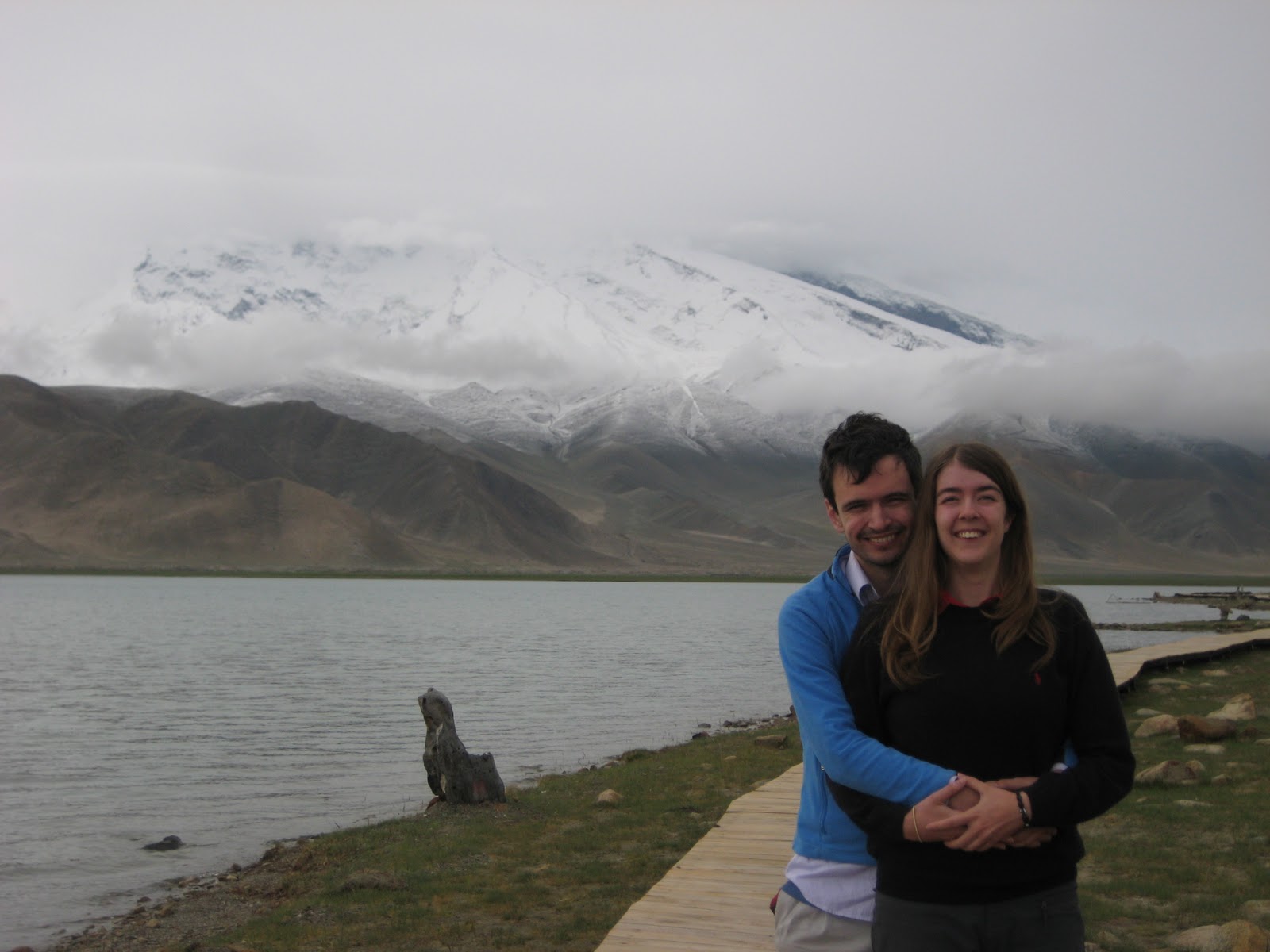
  • Most people who have lived in China for an extended period have one horrible food poisoning story.  Molly and I had ours in one of the most beautiful places in the world.  We had travelled up to Lake Karakul, high in the Himalayas bordering Kyrgyzstan.  Suffering altitude sickness, and having struggled to hold food down for two days, Andrew H was in a terrible state, but was nothing on Molly.  Molly was in deep trouble if we did not get foods into her quickly.  We headed into the restaurant, only to find out they were out of everything except tasteless buns, a bland seaweed soup and rice.  For two hours, Andrew H nursed Molly, feeding her the concoction.  It was a scary and difficult time, but we did enough to keep Molly going.  Thankfully by the next morning we had recovered enough to enjoy the stunning scenery.  (many thanks to Andrew S for all he did for us in this tricky time)


The aftermath at the glorious Lake Karakul

Lesson 2: The world is not stable, but instability can bring amazing opportunities.

How did I learn this?

  • China jobs for expats have a habit of disappearing or changing with little notice.  At one stage my job was suddenly changed and I was left vulnerable. Luckily I quickly found a job at the Department of Agriculture.  Working at the Agriculture office for five and a half months was a wonderful experience.  Amy, James, Nancy and Cindy created a positive work environment that was only punctured by regular games of table tennis.


DAFF staff - Great working environment, and then great people to hand around with (Sadly no picture of Nancy - too busy playing table tennis!)


  • Beijing is an amazingly flexible city.  Go away for a week and you’ll come back to find half the shops had changed hands  and your favourite ice cream place has shut down.  The change did provide benefits however, encouraging you to go out and explore the changes and find yourself a new favourite ice cream shop.

Lesson 3: Abject poverty still exists, and we are fortunate to avoid it.

How did I learn this?

  • People beg in developed countries, but the sheer scale of poverty only hits home when you are in a developing country.  Missing limbs and burnt skin are common among Chinese beggars, but the strongest impact anyone had on me was a lady who often lay near Tuanjiehu station in eastern Beijing.  She was young, but could not / would not stand, as the burns across her body were too severe.  In Australia, she would be treated and would probably lead a relatively normal life. In China, she is left to beg on the streets.

  • China’s governance system leaves local governments with low tax revenues and high spending requirements.  To make up the gap, local governments seize farming land, selling it to developers for a fat profit.  The displaced farmers are given minimal compensation, leading many to end up in poverty.  Other farmers are left fearing the government could seize their property at any moment.


Sunday, 30 October 2011

Wonderful wedding and then sadness..


October has been a life changing month.  Settling into our Petersham home has been overshadowed by two events, one really happy and one terribly sad.

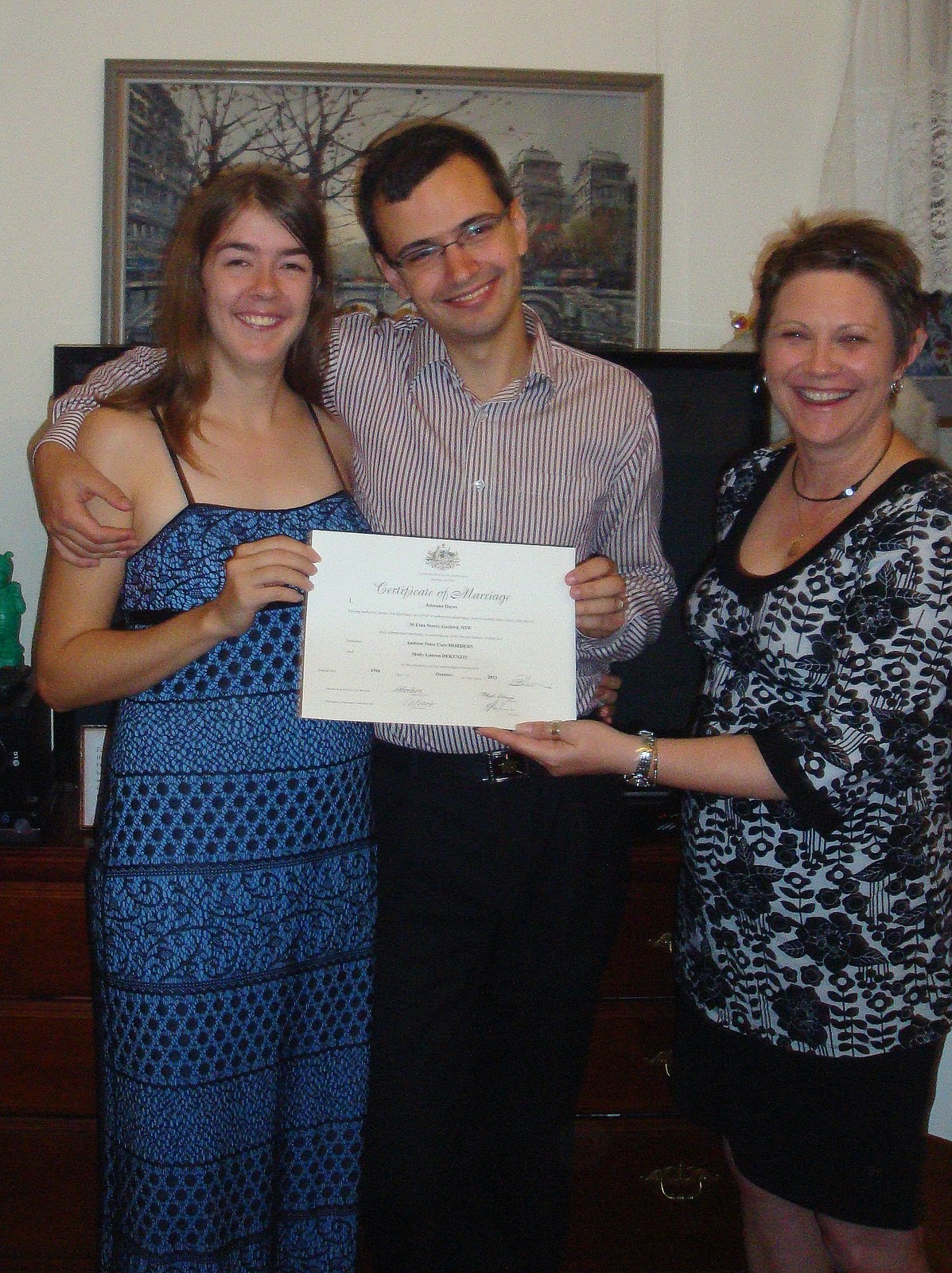
On Saturday 15th October Molldrew got married in a simple ceremony held at Andrew’s Dad’s place.  It was a small event that will be followed by a bigger party in Sydney and a renewal of the vows wedding ceremony in the United States.  It was wonderful celebrating our love in such a fashion.  Many thanks to Andrew’s Dad and Lee for their help with the event.  We had a three day honeymoon at the beach, and plan to have a proper honeymoon (probably in Iceland) after the renewal of the vows in the United States.


Just four days later Molly’s grammie, Lucille Gertrude McKenzie, died.  Lucille was an intelligent, talented woman who had a keen mind even as her health diminished.  Watching Lucille’s spirit transcend into her artwork even as arthritis affected her hands showed her immense power.  We were so happy that we got to spend as much time as we did with her when we were in the US a month ago, and very grateful that Andrew got to meet her.  She is missed.

Having dealt with two large events so close together, it really drives home what is important in our relationship.  While the wedding was great fun, it wasn’t a big changing moment in our relationship.  The moment that brought us together was our wonderful 66.5-hour train journey from Beijing to the Pakistani part of the Himalayas in July 2010.  The trip had immense highs (beautiful scenery, food and companionship) and lows (food poisoning that you wouldn’t believe!).  Going through the trip experiences together bonded us, and convinced us that we were the right people to spend the rest of our lives with. (We will have to blog on that trip soon.)

In the end, the bigger event in terms of our relationship was the sad death of Molly’s grammie.  With Molly being so far away from her family, the two of us bonded even closer together to deal with the sad loss.

We look forward to getting the chance to celebrate our wedding with friends and family in both Australia and the US!